
Presseartikel MAFO
Rebekka Nurkanovic
01.06.2022
A lab changes ownership
Experience with a company takeover
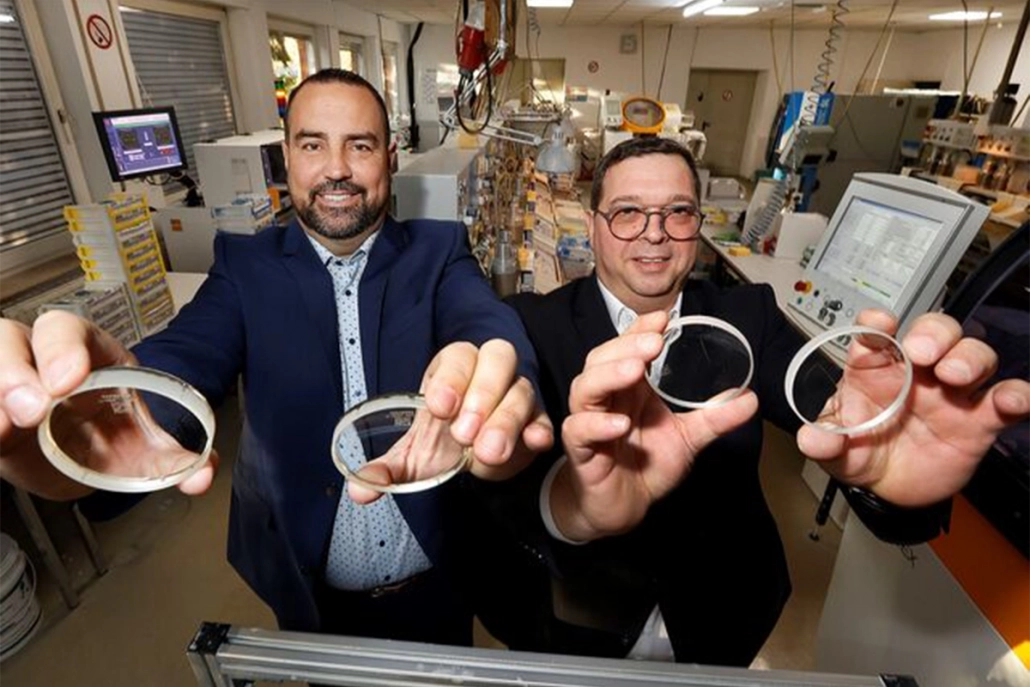
Taking over a company is always an adventure. A number of points have to be taken into account in advance, and then the transition has to be as smooth as possible. Korhan Gazi and Martin Ulm took the plunge and left their secure jobs at one of the largest machine manufacturers in the optical industry to become self-employed. Since May 2022, they are the new owners of the previous family business Optik Weber Brillengläser GmbH in Kamen, Germany. In an interview with MAFO, they shared their experience in the takeover of the company. By Rebekka Nurkanovic
How did you choose Optik Weber and how long did the takeover process take?
Ulm: I was familiar with Optik Weber because I had already installed machines there as a service technician and knew the processes. So it was clear to me what we were taking over and what potential the company had. We had learned in 2021 that Mr. Weber wanted to hand over the company for reasons of age and was looking for a successor. When we decided to go into business for ourselves, we approached him and found that the chemistry was right for both sides. For Mr. Weber it was important that the successors act in his sense and that is what we do. We took over all employees with pleasure, nobody was dismissed. On the contrary, the team was expanded.
Gazi: I already knew the customer base from my time as a salesman for machines and auxiliary and operating materials. So we both already knew what to expect here and that Optik Weber, with a production area of 750 square meters and a storage area of 200-250 square meters, offered a lot of future potential. It took about eight months from the first telephone call with Mr. Weber to the signing of the contract. That’s very fast and involved a lot of stress. In retrospect, I would say you should plan for a year in total, because you never know what small issues will come up that lead to delays.
What was or is the biggest challenge in acquiring the company?
Gazi: The first talks took place during the height of the corona pandemic. No sooner had we decided to take over the company than the war in Ukraine broke out. We had already initiated everything and therefore just hoped that we would get through the crisis well.
Ulm: The big question was how the market would behave and whether it might collapse. With corona, it turned out that there was no major collapse. But the skyrocketing energy costs in Germany are already making themselves felt. So we’ve had a little bit of a headache in terms of how the market is going to develop and whether we’re going to be able to sustain that. So far, however, everything is good.
What general factors did you take into account in your decision?
Gazi: For example, you have to think about the age of the machinery and the control of the production flow. Other important factors are the qualification or the level of knowledge of the employees and of course the existing customer base. In our industry it is hardly possible to start from scratch without already having a customer base, because the market is saturated with different manufacturers. With Optik Weber, we have taken over a company that has already been on the German market for 60 years and has established a name that stands for quality.
Ulm: We also conducted an analysis of suppliers and looked for optimization opportunities. By optimizing purchasing, we uncovered great savings potential. Again, our background knowledge was enormously helpful because we know the quality of the suppliers. Our good contacts in the industry are a great advantage and we are a perfect duo with our respective backgrounds.
Gazi: Exactly, I take care of sales and purchasing and Mr. Ulm takes care of the technology. He can repair machines himself when a fault occurs and we avoid a lot of downtime and service costs as a result.
What cost factors did you take into account?
Gazi: On the one hand, there are the wage costs that have to be financed in advance at the beginning. On the other hand, modernization costs for the machinery have to be considered, but of course there is also potential for savings. For us, the savings potential lies in purchasing, maintenance and the optimization of processes. We were supported in the process by a very good consultant and would always advise Neues Text-Element consulting additional expertise in order to identify and assess risks.
What is important to ensure that the handover from the old to the new owner goes as smoothly as possible?
Ulm: Preparation is very important to ensure that the handover runs smoothly on the due date. The preparation has mainly to do with authorities. For example, you should make sure that you have the tax number before the handover, because at least the German state takes a very long time to issue a tax number.
Gazi: It is also important to inform customers and suppliers in good time that there is a new VAT number. Even before making the decision to take over, it should also be clarified that contracts can be taken over, e.g. with insurance companies or existing customers. We are pleased that Mr. Weber has supported us throughout the entire process and will continue to accompany us at least until the end of the year. We value his advice very much, because he knows the internal processes and the employees very well.
“We also conducted an analysis of suppliers and looked for optimization opportunities. By optimizing purchasing, we uncovered
great savings potential.” Martin Ulm
Ulm: From our point of view, it is also very important that we become a team with the entire workforce, because you can only be successful as a team. The employees have received us well and see the restructuring positively. We are also aware that they are the greatest asset of any company, not the building or the machines.
How did you manage to involve employees in the process?
Gazi: We have informed the employees in advance about the takeover and our goals, and made it clear that we need the team for this. We try to communicate all changes and processes clearly. For new products, for example, we have held training sessions and explained the benefits. It is important to us that it is clear to everyone that they can come to us with a problem so that we can find a solution together.
Ulm: I think everyone has noticed by now that it’s important to us that everyone goes to work singing and whistling and comes out singing again. We are convinced that you can only perform at your best if you enjoy your work, and we don’t want to frustrate anyone by restricting them or forcing them into a mold that doesn’t fit. Wherever possible, we give employees the freedom to make decisions and take action, so that they feel valued and respected. For us, it is important that employees who are in contact with customers have a sound basic knowledge and know every step of production.
What is your vision for the future?
Ulm: We want to expand. We want to grow step by step, create jobs and not stay put. The aim is to increase production significantly. In order to implement this, a high automation rate in production is necessary. For this purpose, we are continuously expanding the existing automation in order to optimize the throughput times in production.
We are very much looking forward to the future innovations that we will realize together with our team and our customers.
Gazi: We operate throughout Europe and would like to expand further. In the long term, our goal is to sell worldwide. Our vision for the future is to build a service-oriented, modern and independent production facility, which responds to the individual wishes of the customer and where people work together. We want to stand out and distance ourselves from entrenched structures and values.